The default assumption when a freelancer says "I'm bad with money" is that they need accounting. They need books, they need categorisation, they need a tax-ready system. So we hand them a smaller version of the tool we'd hand an accountant, and we wait for them to use it. They don't, of course. They use it for two weeks, abandon it, and go back to a spreadsheet they update once a quarter the night before they meet their accountant.
We diagnose this as a discipline problem. It isn't. It's a product problem. Accounting tools answer the wrong question.
The question that actually matters
The question a freelancer needs answered is not what did I earn last month, broken down by category. It's am I safe right now? And the follow-up: what changed since I last looked? Those are operating questions, not accounting questions. They're about the present and the immediate future, not the recent past.
Accounting answers what happened. Operators need to know what's happening, and what's about to.
Accounting tools can technically produce the answer to those operating questions, but only after several minutes of clicking, filtering, and interpreting. The information is in there, somewhere. It is not the foreground of the product, because the product wasn't designed for the question. It was designed for tax compliance, with operating insight as a side effect.
What changes when visibility is the product
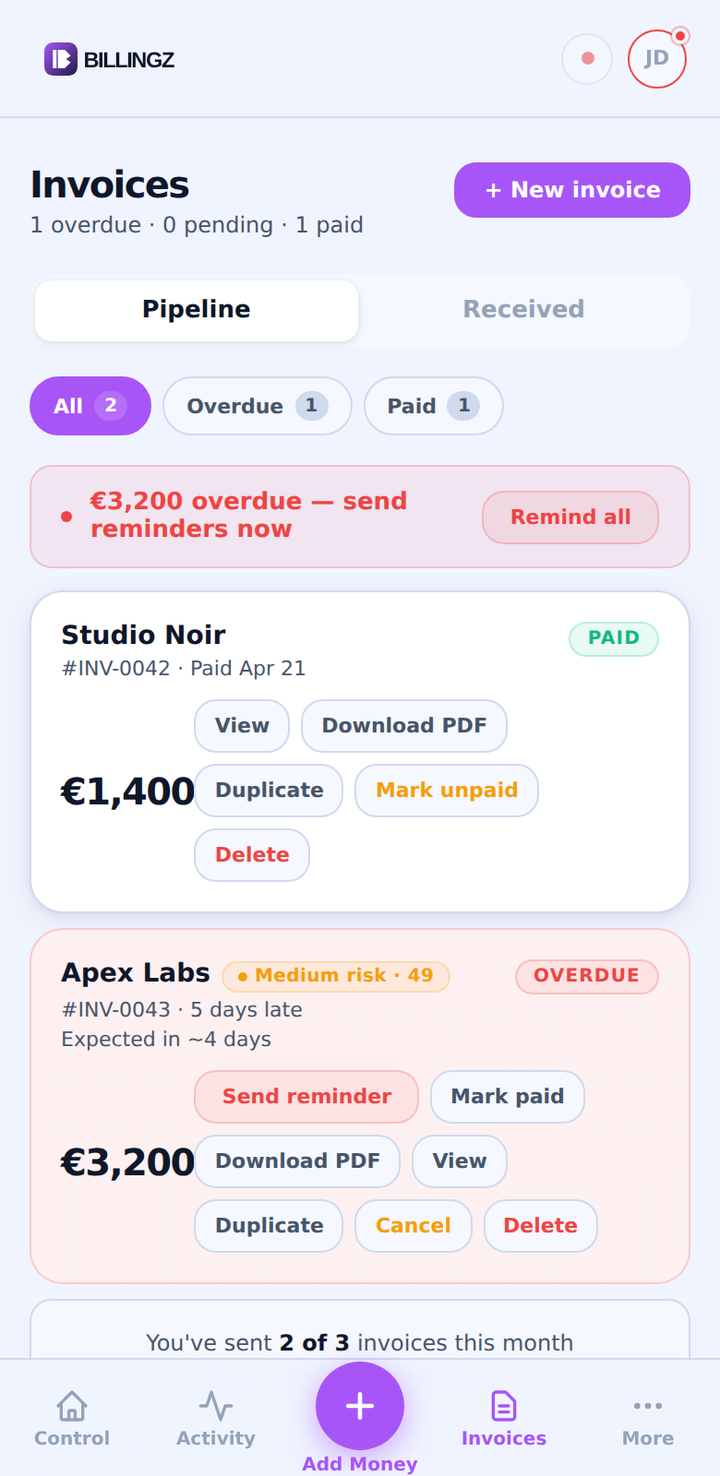
When you build for visibility instead of bookkeeping, three things shift. The dominant screen changes, there's one number, not a dashboard of twelve. The activity feed changes, every event is annotated by its impact on that one number, not just logged. And the calls to action change, the product surfaces what to do next, not what to record next.
None of this is incompatible with eventually exporting clean records to an accountant. The data structure is the same. The product foreground is different. That distinction, what's on top, what's available on demand, is the entire difference between a tool that gets used daily and a tool that gets opened twice a year.
Why this matters for the category
Most freelance financial software is competing on features the user doesn't need to evaluate well: which categorisation engine is more accurate, which integrations are deeper, which receipt scanner is smarter. None of those determine whether the user feels in control. Control is a feeling produced by visibility, and visibility is a design decision, not a feature checklist.
That's the bet behind Billingz. Not that freelancers will love accounting more. That they'll choose a product that finally answers the question they actually have.
If this resonates, I’d love to hear from you.