Every week there is another announcement. AI will replace finance teams. AI will automate bookkeeping. AI will connect directly to bank accounts. The headlines are loud, the rounds are large, and the excitement is understandable. We are watching one of the most important technological shifts of our generation.
Underneath the noise, something simpler is true. Most founders building in this space are misunderstanding the problem.
Freelancers and independent operators do not wake up wondering how to use more AI. They wake up wondering which invoices are overdue, whether they can pay tax next month, why the business feels busy but financially unclear, where the money actually went, and whether they are growing or just surviving harder.
The issue is rarely a lack of intelligence. It is a lack of operational clarity.
The fragmentation problem
For years, small business finance software evolved around functions instead of understanding. One tool for invoices. One for expenses. One for banking. One for taxes. One for reporting. The category became a collection of features instead of an environment that helps an operator understand the state of their business.
That fragmentation creates silent stress. And silent stress is one of the least discussed realities of running a one-person business. Most small businesses do not fail dramatically. They fail quietly, through delayed visibility, poor timing, operational fatigue, and slow reactions to problems that should have been visible months earlier.
This is what most of the AI conversation is missing. AI alone is not the product. AI is becoming infrastructure.
AI alone is not the product. AI is becoming infrastructure.
The electricity comparison
Large language models are extraordinary tools. They summarize, categorize, generate insights, and automate processes at a level that was unimaginable a few years ago. They will become part of nearly every serious software product. But the existence of intelligence does not automatically create operational systems.
A freelancer still needs structured invoices, organized expenses, payment visibility, recurring workflows, tax awareness, and financial discipline. None of that is a model problem. It is a system problem.
We are entering a phase where AI will become similar to electricity inside software. Important, transformative, and everywhere, but increasingly invisible to the end user. People do not buy products because they contain electricity. Eventually, they will not buy products because they contain AI either. They will buy products that make their work simpler, clearer, safer, and less stressful.
Trust is the second moat
There is also a factor most of the discourse underestimates. Trust.
Finance is not entertainment. Operators do not want chaos connected directly to their bank accounts. They want systems that feel dependable, predictable, and understandable. That is one reason I believe the future belongs to vertical operational platforms rather than generic AI assistants.
An industry-specific system understands context. A platform built around freelancers and independent businesses knows the rhythm of late payments, cashflow timing, VAT pressure, seasonal instability, and the emotional reality of running a small business. A general-purpose AI tool does not, and probably never will.
Building from the foundation
The next generation of platforms will likely combine operational workflows, embedded intelligence, financial infrastructure, automation, predictive awareness, and eventually banking layers. But the order matters. The companies that survive will earn trust first through operational value, and only then expand into deeper financial ecosystems.
Many founders today are trying to start from the endgame instead of building the foundation.
Technology alone rarely creates durable companies. Behavioral understanding does. Operational understanding does. Trust does. Clarity does.
Technology alone rarely creates durable companies. Behavioral understanding does. Operational understanding does. Trust does. Clarity does.
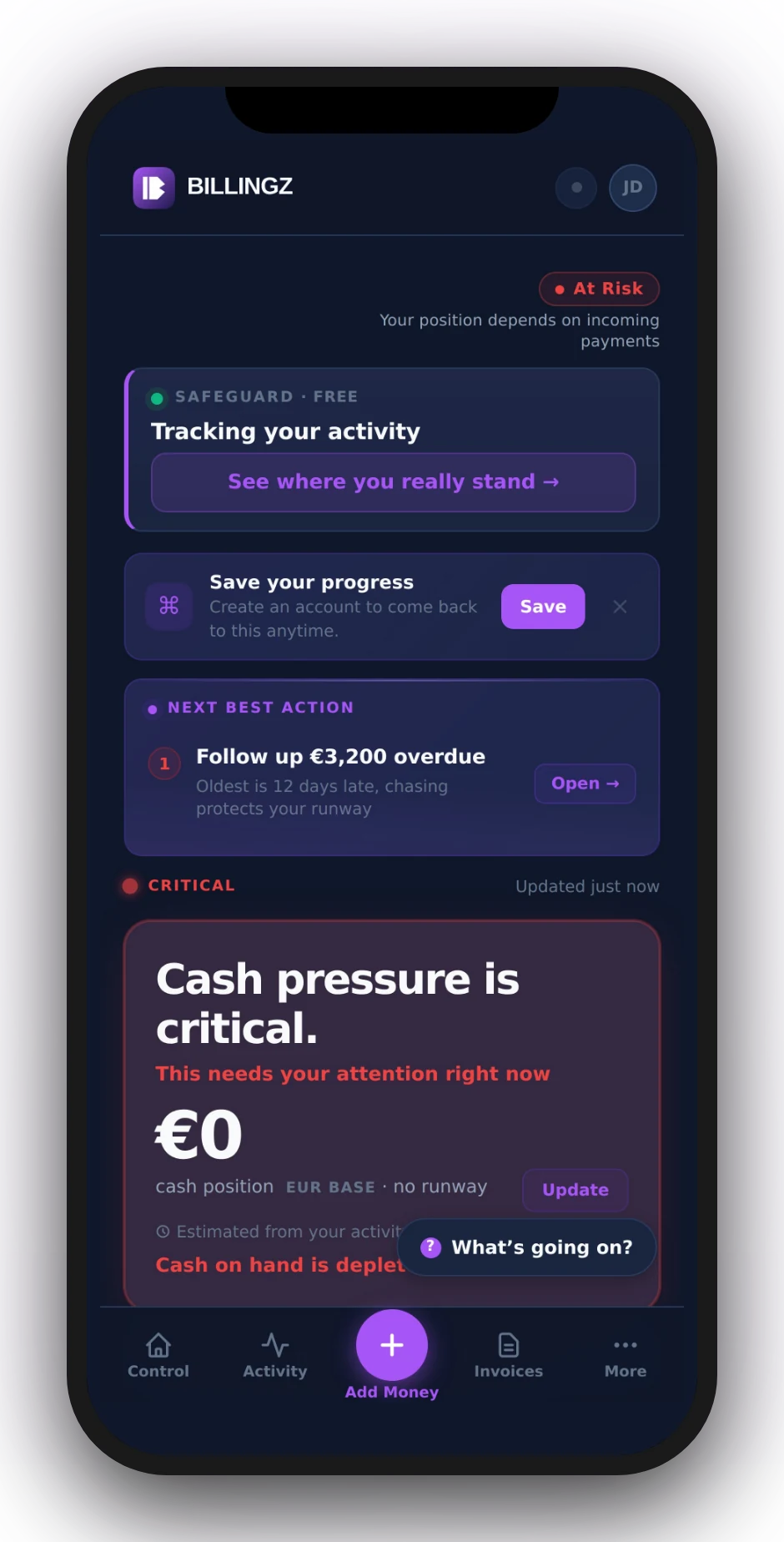
That is the philosophy behind what we are building. Not AI for the sake of AI. Not noise dressed as innovation. Not complexity hidden behind futuristic language. An environment where independent businesses can see where they stand, know what requires attention, and operate with confidence.
AI will absolutely play a role in that future. But quietly. As infrastructure. Not as the identity.
This is the philosophy behind Billingz.