For most of my working life I believed that a serious career was supposed to feel heavy.
Heavier the higher you climbed. Heavier the more people counted on you. Heavier the more countries you were responsible for. If it did not feel heavy, you probably were not doing enough.
I do not remember choosing that belief. I inherited it, the way we inherit accents or family recipes. It sat quietly in the background of every decision I made across eighteen years of banking, cross-border operations, corporate boards, and P&Ls of businesses in more than fifty countries. For a long stretch it produced what looked like results. Titles arrived. Responsibilities compounded. So did the sense of weight.
What I want to write down here I did not arrive at cleanly. Most of it came slowly, and much of it came from the inconvenient discovery that I had spent years believing the opposite. The lines that follow are not conclusions. They are the residue of a lot of quiet revisions.
Somewhere in the middle of all of that, the equation stopped working.
Nothing dramatic. No breakdown. No epiphany while watching the sun rise over an airport lounge. Just an accumulating suspicion that I had confused two very different things: doing important work, and constantly proving that the work was important. They can look almost identical from the outside. From the inside they feel completely different.
The first one leaves you tired but whole. The second one leaves you tired and slightly less like yourself each year.

On no longer admiring chaos.
For most of my career I admired chaos more than I want to admit.
The founder who slept four hours. The executive who took calls from three time zones simultaneously. The team that shipped through a weekend because "we had to." I mistook these things for seriousness. Sometimes they were. More often they were the visible symptoms of poorly designed organizations, celebrated because celebrating them was easier than fixing them.
There is a particular kind of pride we take in exhaustion. It signals to the world that we are needed. Being needed feels like belonging. Belonging feels like meaning. And so we quietly build workplaces that generate exhaustion on purpose, because it produces the feeling we are looking for.
I understand it now. I understand it in myself. That is why I no longer trust it.
Peace is the most underrated word in business.
The older I get, the more convinced I become that peace is the most underrated word in business.
Not comfort. Not softness. Not a lack of ambition. Peace, in the sense of a calm mind that can look at a problem for what it is rather than what it fears. In the sense of a team that can say no to a bad opportunity without needing three meetings to justify it. In the sense of a founder who does not require another crisis in order to feel alive.
A great deal of value is destroyed by leaders who cannot sit with an unhurried moment. They fill it with new projects, new pivots, new reorganizations. The cost is rarely on the balance sheet. It is always paid. Usually by the best people, who leave quietly, tired of noise pretending to be strategy.
Clarity is what separates good decisions from average ones.
Clarity, more than intelligence, is what separates the best decisions I have seen from the average ones.
Most bad decisions I have witnessed inside otherwise capable companies were not the result of bad information. They were the result of unclear thinking. Meetings without a decision maker. Roadmaps written to please multiple audiences. Strategies dressed up as narratives because no one was willing to admit what the real trade off was.
Clear thinking is uncomfortable because it forces choice. Choice creates responsibility. Responsibility creates exposure. So we invent softer languages that allow everyone to nod without agreeing on anything specific. Then we blame execution when the plan quietly falls apart.
Whenever I look back at the best decisions I was part of, they were preceded by a single hour of honest, unambiguous conversation among a small number of people who trusted each other.
Small focused teams outperform large well resourced ones.
I have worked in organizations of many shapes. Small ones with three people. Large ones with thousands. I have seen almost every combination of ambition and structure.
The pattern I keep coming back to is this. Small, focused teams almost always outperform large, well resourced ones, provided the small team has clarity, autonomy, and enough time to think.
Large organizations do not necessarily fail because their people are worse. They fail because coordination cost silently eats the value the individuals produce. Below a certain size, everyone knows why they are doing what they are doing. Above a certain size, most people are performing a role in a play whose script no one has read from start to finish.
There are exceptions. Well led large organizations exist. They are rarer than the org charts suggest.
Fear can produce short bursts of performance. Trust produces sustained good judgment when no one is watching.
Trust scales better than fear.
The most durable competitive advantage I have ever seen in a company is trust.
Not values-on-a-poster trust. The real kind. The kind where a colleague makes a call late at night and you already know why they made it before they explain it, because you understand how they think and you know they understand how you think. That kind of trust removes friction from every part of a business at once. It compresses meetings. It shortens documents. It removes the middle layers of oversight that exist mostly to compensate for a lack of it.
Fear can produce short bursts of performance. Trust produces something more valuable. Sustained good judgment when no one is watching.
Fear does not appear as a line item, which is why we underestimate its cost. It appears as talented people who stop volunteering ideas. As decisions escalated one level too high. As small problems that grow into large ones because the person closest to them was afraid to raise a flag.
Money matters. Purpose comes first.
Money matters. I want to be careful here, because it is fashionable in certain circles to pretend it does not. Money buys options. Options buy freedom. Freedom is what allows you to say no to work that would compromise you.
But money is a poor purpose. It is a byproduct of doing something well over a long enough period of time. When it is treated as the point rather than the result, something hollows out. Product decisions get faster and worse. People become interchangeable. Customers become extraction opportunities. All of it looks fine on a quarterly chart, until suddenly it does not.
The best businesses I have been part of, across every industry I have worked in, treated money the way a healthy person treats food. Necessary. Enjoyed. Not confused with the meaning of life.
Culture does most of the work.
Strategy gets most of the attention in books. Culture does most of the work.
I have watched carefully designed strategies fail in cultures that would not carry them. I have watched imperfect strategies succeed in cultures that filled in every gap the plan left behind. Strategy sets direction. Culture decides whether people row.
Culture is not designed by consultants. It is shaped, day by day, by what leaders tolerate, what they reward, what they interrupt, and what they let slide. Every meeting is a signal. Every hire is a signal. Every time a leader says one thing and does another, a small piece of the culture updates itself, quietly, in a direction no one intended.
Which means the leaders who claim to be too busy for culture work are usually the ones producing the loudest culture of all. They just are not the ones deciding what it says.
The question that eventually shifts.
At some point in a career, the question shifts.
For a long time, the question is: how far can I go? What is the highest position, the biggest region, the largest team I can be trusted with?
Later, if you are lucky and reflective, the question changes. What kind of place have I actually built for the people who work with me? Is it somewhere they can think clearly? Somewhere they can raise children and still show up as themselves in the morning? Somewhere they will remember with warmth, not relief, when they eventually move on?
The first question sounds ambitious. The second one is far more ambitious, because it demands honesty about what you have really been optimizing for.
Anyone can build a company that grows. Fewer can build one where growth does not require breaking the people who make it possible.
On success that improves your life instead of consuming it.
I have come to believe, quietly and without needing to argue for it, that success is supposed to improve your life, not consume it.
If your business is growing but you are shrinking, that is not success. It is a specific kind of failure that the market takes a long time to price in. The health you spent. The relationships you neglected. The version of yourself you left behind at some airport in 2015. Those show up eventually, usually at the worst possible moment.
The same principle applies to organizations. A company that grows revenues while burning through its best people is not thriving. It is running down an asset that does not appear on the balance sheet.
Sustainability is not the opposite of ambition. It is the honest form of it.
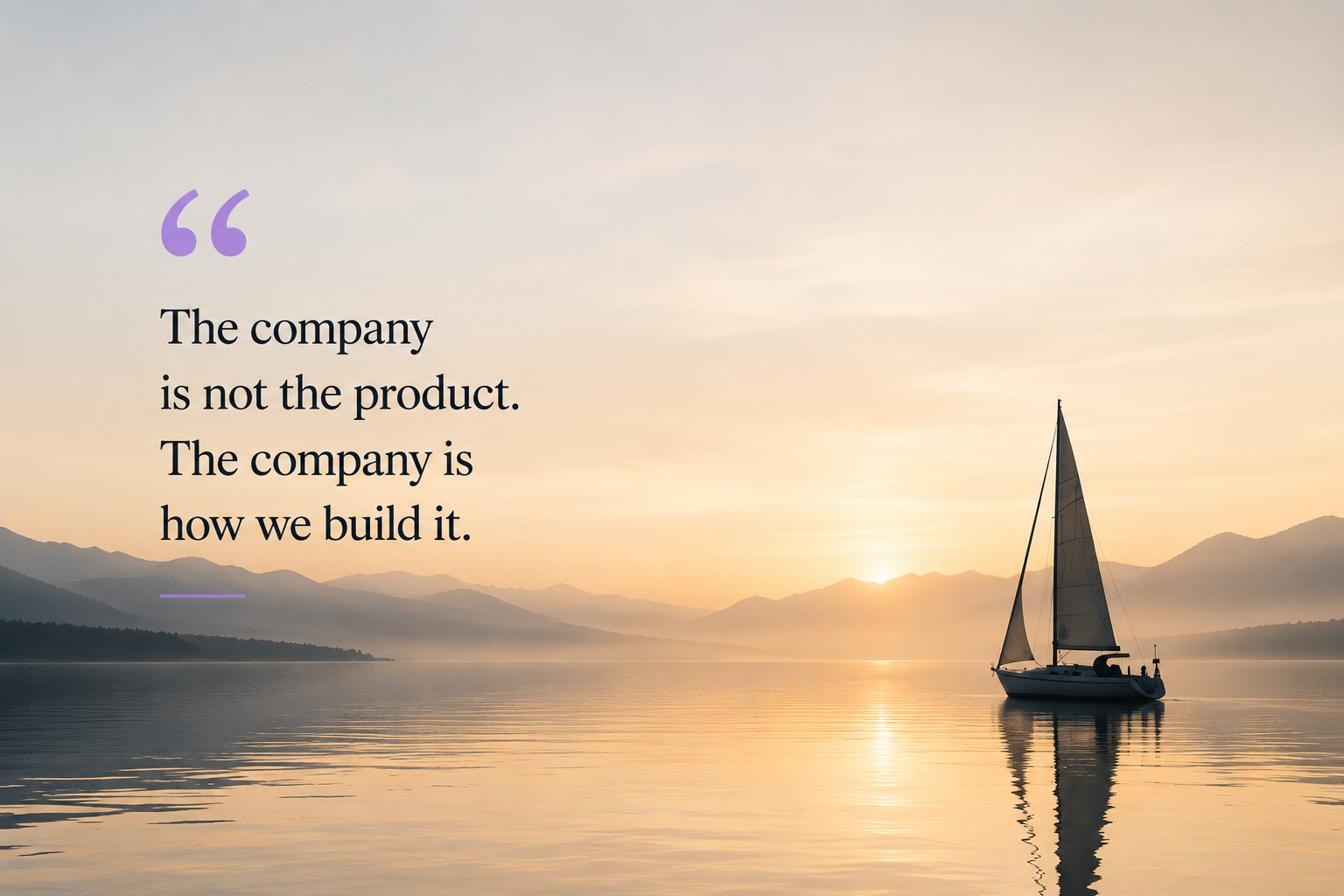
The company I want to build.
For a long time, everything I have written above lived as private conviction. It shaped how I led. It shaped how I hired, and how I let people go, and how I sat in meetings that felt off but that I did not always have the standing to redirect. It shaped what I admired in colleagues and what I quietly refused to become.
What I did not have, for most of that time, was the opportunity to build an entire company around any of it.
Recently, for the first time, that changed. What began, at first, as a small idea for a new kind of financial operating system for independent operators eventually became Billingz.
None of what I have written above was imported into it after the fact. It was there before the company had a name.
Peace is not a bonus feature. It is part of how we work.
Clarity is not a communication style. It is a filter for what we agree to do.
Trust is not a value on a wall. It is the operating system.
Money matters. Purpose comes first.
Billingz is small. It is focused. It is unhurried in the ways that matter, and quick in the ways that serve users. It is the first place I have ever helped shape from the ground up, and probably the last one I will build with this particular intensity. That is not a complaint. It is a kind of gratitude.
Build the company you would want to work in on a Tuesday, not just the one you can describe at a conference on a Friday.
Coda.
I do not know what Billingz will become.
Some companies grow. Some stay small. Some quietly fade. I have lived long enough inside businesses of many shapes to know that the story is rarely written by the people who started it.
What I do know is smaller, and closer to the ground.
If, twenty years from now, the people who spent part of their working lives inside this company can look back and honestly say that they did good work, without losing themselves in the process, and that they were treated with clarity and trust while doing it, then whatever the numbers say, we will have built the right thing.
The numbers will land where they land. The rest is what I am actually trying to make.
Radovan Vitosevic
Written in July 2026
These Notes are not written to teach. They are written to preserve ideas that experience has taught me before time quietly edits them.
Some begin as observations. Some become conversations. Some eventually become chapters in future books.
Together, they form an evolving record of how I think about business, leadership, decision-making, and building meaningful companies.
Radovan Vitosevic is an entrepreneur, business leader, and author.
After more than two decades in banking, international corporate leadership, entrepreneurship, and board positions across multiple countries, he now focuses on building businesses with long-term value and writing about the principles that shape them.
His essays explore leadership, entrepreneurship, decision-making, company building, and a quieter definition of success.
These Notes reflect my personal experience and perspective after more than two decades in business.
They are not intended as universal truths, nor should they replace professional financial, legal, investment, or other professional advice where appropriate.
Unless otherwise stated, the views expressed here are my own and do not represent those of any past or present organization with which I have been associated.
Like any perspective, these ideas remain open to challenge, refinement, and change as I continue to learn.
A practical system for tracking income, expenses, taxes, cash flow, and runway. No spreadsheets. No accountant on retainer.
The next decade will not be won by the loudest AI announcements. It will be won by the platforms that turn intelligence into quiet operational clarity.
Twenty years inside global corporations, and what money taught me. A quiet look at the business memoir I am putting together for 2027.